

The attack pattern has shifted. Most intrusions now begin with a valid credential or session, not a breached perimeter. The 2026 Sophos Active Adversary Report, drawn from 661 incident response and managed detection cases, documented a continued rise in attacks rooted in identity compromise. Cloud sprawl and the spread of non-human identities have widened the attack surface in federal and commercial environments.
For defenders, identity becomes the primary control plane. The perimeter controls that anchored earlier defenses are no longer sufficient. Building a defensible posture means treating identity infrastructure with the same rigor previously reserved for the perimeter. In this post, we’ll explore how your organization can strengthen identity security posture against credential-based attacks, from authentication controls to workforce training.
Identity-Based Attacks: An Overview
Identity-based attacks target the verification layer, not the perimeter. The attacker’s goal is to operate as a real user. Some methods steal credentials directly through infostealers. Others use adversary-in-the-middle proxies to capture session cookies after multifactor authentication (MFA) completes, then replay those cookies against the relying party.
Open authorization (OAuth) consent abuse grants persistent access without requiring a login or password. Non-human identities (such as service accounts and API keys) are also frequent targets because they hold high privileges and rarely rotate. Once inside, adversaries blend with legitimate activity, which limits the value of tools tuned to malware artifacts. Detection becomes a behavior problem rather than a signature problem.
Why Education Is a Critical Gap
Technical controls address only part of the identity surface. Social engineering remains an efficient path to valid credentials because it targets human judgment rather than technical systems. Many identity compromises begin with a human decision: approving an MFA push or entering credentials into a fraudulent page. Conventional awareness training was built around the surface-level indicators of earlier phishing campaigns.
AI-generated content carries none of those indicators. Techniques such as voice cloning and deepfake video extend the same problem to phone and video channels. Annual training leaves long gaps between exposures (gaps that attackers actively exploit). The problem extends beyond end users: help desk staff and developers are also high-value targets. Both require role-specific training that reflects current attack methods.
Building a Strong Identity Security Posture
A defensible posture pairs technical controls with workforce capability. The four areas below apply across federal mission environments and commercial enterprises.
1. Phishing-Resistant Authentication
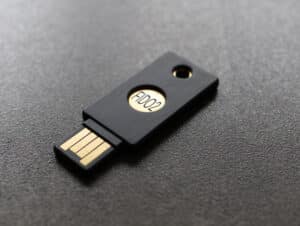
FIDO2 authenticators are hardware devices that verify a user’s identity using public-key cryptography instead of traditional passwords.
Replace SMS-based and push-based MFA with phishing-resistant factors (such as fast IDentity online 2 (FIDO2) authenticators), which bind authentication to the relying party and cannot be replayed by an attacker proxying the login page.
Prioritize administrative accounts and federation infrastructure, then expand coverage to any user with access to sensitive systems. Layer device assurance controls so that a valid credential cannot authenticate from an unmanaged endpoint. Document break-glass procedures and review them on the same cadence as primary controls.
2. Least Privilege Across Humans and Machines
Conduct entitlement reviews on a defined cadence, removing dormant accounts and stale tokens. Eliminate standing administrative rights wherever possible and issue privileged access through just-in-time workflows with session recording.
Non-human identities require the same discipline. Each should have a designated owner, be scoped to the minimum required access, and rotate on a schedule that reflects the sensitivity of what it grants.
3. Posture Management and Threat Detection
Identity Security Posture Management (ISPM) and Identity Threat Detection and Response (ITDR) work as a pair. ISPM provides continuous visibility into identity configurations across on-premises directories and cloud identity and access management (IAM), identifying misconfigurations and unused entitlements that audit cycles miss. Active Directory remains a high-value target in hybrid environments, where compromise frequently grants access to cloud workloads through synced identities.
ITDR monitors authentication and authorization events for behavioral anomalies, such as impossible travel or session token reuse. Telemetry from both on-premises directories and cloud identity providers should feed a central pipeline that correlates identity signals with endpoint and network data, with alerts mapped to defined containment actions. Session revocation and credential rotation must be fast enough to disrupt an active intrusion.
4. Workforce Training
Effective training pairs technical controls with role-based exercises that reflect current attack methods. For example, phishing simulations should cover voice and text channels, not just email. Establish out-of-band confirmation for high-impact actions such as credential resets and privileged role assignments.
Run targeted exercises for privileged users and executives, since adversaries tailor pretexts to high-value roles. Measure behavior change, too. A program that runs once a year cannot keep pace with attack techniques that evolve on a much shorter cycle.
Strengthen Your Identity Security Posture with SealingTech
SealingTech delivers innovative cyber solutions for federal, military, and enterprise customers with built-in identity verification capability. Through Zero Trust integration at the tactical edge, our rapidly deployable Cyber-Fly-Away Kits and compact, TAA-compliant AegisEdge MicroServers enable continuous monitoring and identity verification in operational technology (OT) and industrial control systems (ICS) environments.
 SealingTech’s Zepharis™ Software Suite also provides a deployable, AI-powered identity and security posture framework that works in isolated, high-security environments, combining offline AI capability, rapid provisioning, and integrated threat detection to protect both identity and system integration.
Contact our team to learn more.
Related Articles
Transforming Cyber Challenges into Real-World Customer Solutions
Intuitive and skilled problem solvers, SealingTech engineers design and build defensive cyber solutions for challenging and unpredictable environments where critical missions are at stake. They tackle issues that directly impact…
How Geopolitics Defines Cybersecurity for Critical Infrastructure
Geopolitics and cybersecurity increasingly converge. State-sponsored hackers target critical infrastructure as part of broader international competition. Governments use cyber operations for espionage, influence, and sabotage to apply pressure without kinetic…
Could your news use a jolt?
Find out what’s happening across the cyber landscape every month with The Lightning Report.
Be privy to the latest trends and evolutions, along with strategies to safeguard your government agency or enterprise from cyber threats. Subscribe now.