
Zero Trust Network Access replaces implicit network trust with continuous, identity-based verification of every access request. Rather than placing a user on the network, it grants application-level access after confirming identity and device state. For federal and defense organizations operating under zero trust mandates, ZTNA is where policy becomes enforced practice.
ZTNA: Core Components

Together, ZTNA’s core components limit access to the specific resource a user needs, which reduces the attack surface and contains lateral movement if an account or device is compromised.
ZTNA relies on several components that work together to evaluate and enforce each access decision under a single principle: never trust, always verify. The core components are:
- Identity and access management authenticates users and non-person entities through such methods as phishing-resistant multi-factor authentication and role-based access control.
- The policy engine evaluates each request against defined rules, weighing identity, device posture, location, and other context before reaching a decision.
- The policy enforcement point, usually a gateway or proxy, executes the decision and brokers the connection without exposing the application to the open network.
- Device posture assessment checks the requesting endpoint for compliance, confirming current operating systems, active endpoint protection, and required encryption.
- Continuous monitoring re-evaluates trust throughout the session rather than granting it once at login.
Together, these components limit access to the specific resource a user needs, which reduces the attack surface and contains lateral movement if an account or device is compromised.
ZTNA’s Role in Federal Agencies
Federal agencies do not adopt ZTNA in isolation. They implement it within a broader zero trust architecture required by federal mandates. Executive Order 14028 set the direction in 2021, and OMB Memorandum M-22-09 followed in January 2022 with a Federal Zero Trust Strategy that required civilian agencies to meet specific goals by the end of fiscal year 2024. Two frameworks guide that work:
- The Cybersecurity and Infrastructure Security Agency (CISA) Zero Trust Maturity Model, now at version 2.0, organizes civilian progress across five pillars: Identity, Devices, Networks, Applications and Workloads, and Data.
- The Department of War (DoW) Zero Trust Strategy spans seven pillars and 152 activities, of which 91 form the target-level baseline due by the end of fiscal year 2027.
ZTNA maps directly to the identity and network pillars in these frameworks. It enforces per-session, least-privilege access, treats internal networks as untrusted, and replaces the broad access granted by legacy virtual private networks. NIST Special Publication 800-207 provides the underlying architecture.
Recent Developments
The federal zero trust landscape continues to shift in ways that matter for agencies and contractors planning their architectures:
- In January 2025, Executive Order 14144 reaffirmed the federal commitment to zero trust and directed the Office of Management and Budget to revise Circular A-130 to promote migration to zero trust architectures, along with endpoint detection and response, encryption, network segmentation, and phishing-resistant multi-factor authentication.
- In June 2025, Executive Order 14306 amended that order. It scaled back several contractor obligations but left the core zero trust framework intact, including the identity and authentication requirements of the Federal Zero Trust Strategy.
- That same month, NIST finalized Special Publication 1800-35, Implementing a Zero Trust Architecture, which documents 19 sample implementations built with 24 vendors and maps them to the NIST Cybersecurity Framework and SP 800-53.
The Department of War’s timeline has not changed: defense components and Defense Industrial Base partners are expected to reach target-level zero trust by the end of fiscal year 2027.
Achieve Your Zero Trust Objectives with SealingTech
At SealingTech, we engineer high-performance hardware, software, and deployable systems for federal and defense missions. Our work spans enterprise cyber operations, edge computing, and rapidly deployable Kits built for environments where conventional infrastructure does not reach.
Contact our team to discuss how our advanced products and proven technology can support your zero trust objectives.
FAQs
What Is the Difference Between ZTNA and a VPN?
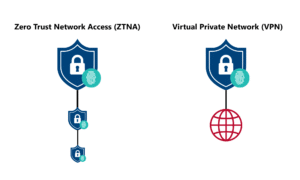
Where traditional VPNs grant broad network access after a single login, ZTNA verifies user identity and device posture before it greenlights access.
A virtual private network often grants access to the network after a single login, which can expose more than a user needs. ZTNA grants access to individual applications after verifying identity and device posture, and it keeps those applications hidden from unauthorized users. This narrower scope limits lateral movement if credentials are stolen.
Is ZTNA the Same as a Zero Trust Architecture?
No. Zero trust architecture is the broader security model defined in NIST Special Publication 800-207. ZTNA is one part of that model, focused on secure access to applications and resources. Agencies deploy ZTNA as part of a broader effort that also covers data, devices, and analytics.
Does ZTNA Apply to Classified Networks?
Yes. The DoW Zero Trust Strategy applies zero trust principles across both the Non-Classified Internet Protocol Router Network (NIPRNet) and the Secret Internet Protocol Router Network (SIPRNet). Controls based on identity, device posture, and dynamic policy are expected at all classification levels.
How Does ZTNA Relate to SASE?
ZTNA is one capability within the Secure Access Service Edge (SASE) and Security Service Edge (SSE) frameworks. SASE combines ZTNA with functions such as secure web gateways, cloud access security brokers, and firewall-as-a-service. Organizations can deploy ZTNA either on its own or as part of a broader SASE platform.
What is the Deadline for Federal Zero Trust Adoption?
Civilian agencies were directed to meet the goals of the Federal Zero Trust Strategy by the end of fiscal year 2024. Defense components and their Defense Industrial Base partners are expected to reach target-level zero trust by the end of fiscal year 2027, with advanced capabilities to follow by 2032.
Related Articles
National Infrastructure Priority Status: Benefit, Impact, and Why It Matters
The United States is in the midst of a generational investment in the nation’s infrastructure. This modernization effort (spanning energy, transportation, water, and digital systems) arrives alongside an era of…
Autonomous AI Attacks: How Machine-Driven Threats Plan, Execute, and Adapt
Cybersecurity is entering a new phase characterized by autonomous AI attacks, where operations are driven by AI systems rather than direct human control. These systems operate at speeds and scales…
The Role of AI in Cybersecurity: Acceleration and Risk
AI technologies are reshaping the cybersecurity landscape on both the offensive and defensive fronts. Public and private organizations use AI to accelerate threat detection and response. At the same time,…
Could your news use a jolt?
Find out what’s happening across the cyber landscape every month with The Lightning Report.
Be privy to the latest trends and evolutions, along with strategies to safeguard your government agency or enterprise from cyber threats. Subscribe now.