
As a Principal Solutions Architect for SealingTech and proud 20-year US Army Veteran specializing in defensive cyberspace operations, I take the threat of near-peer adversaries seriously. Near-peer adversaries are predatory global competitors with similar capabilities to the United States. They often target the digital battlespace protected by the US Military and the supporting Defense Industrial Base (DIB). This makes it necessary for the Department of Defense (DoD) and its close allies to enhance their technological capabilities and cyber workforce to effectively defend against them and their ever-evolving cyber threats.
In an era that determines winners and losers by one’s ability to adopt and apply continuous innovation, many traditional methods and approaches to capability development within the federal landscape simply are not agile enough to move at the rapid pace that’s needed to meet the growing demands of the DoD’s cyber workforce. When combating global adversary threats, much of the problem lies in the rate of speed these near-peer threat actors can evolve their tactics, techniques, and procedures to degrade, disrupt, and deny military operations.
Rapid Prototype Development
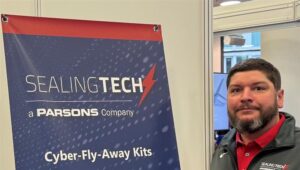
Justin Hunsaker, Principal Solutions Architect, started at SealingTech in 2022. He recently spoke on “Empowering the Cyber Warfighter” at TechNet Transatlantic in Frankfurt, Germany.
SealingTech takes pride in being an agile organization that proactively assesses and integrates advanced capabilities to enhance operational effectiveness. Unlike larger entities, our advantageous size lets us swiftly navigate the design, prototype, and production phase—ensuring rapid innovation and customer customization.
Our in-house research and development (R&D) team fosters an environment where we continually push innovation forward to rapidly prototype and develop new defensive solutions aimed to equip the DoD and its allies with the greatest cyber toolset available to enable mission success. How do we achieve this? By continually looking forward and ideating. We take emerging technologies and proficiently integrate the latest and greatest capabilities into our products. We view our approach to capability development as a partnership between our government and industry partners to create purpose-built solutions for the organizations we support.
Solving Customer Pain Points
In 2015, the US Army needed a customized small form factor modular compute and storage solution with a virtualized software deployable platform that would provide rapid global deployment of cybersecurity capabilities. The system needed to be contained in a carry-on compliant solution that allowed cyber operators to maintain positive control of their Kits.
The original Deployable Defensive Cyber Operations System (DDS) Kits that the Army Cyber Protection Teams used were required to be checked or shipped and often arrived damaged. Many times, these Kits would be held up in foreign customs. Operators would arrive on site to conduct a mission and could not access their Kit.
The Army prototyped approximately seven different versions of airline checked, greater than 70lb (in each case) DDS solutions prior to SealingTech introducing them to the DDS-M. They awarded SealingTech the production contract in 2018.
SealingTech’s carry-on compliant Deployable Defensive Cyber Operations System-Modular (DDS-M) was a true game changer that redefined requirements for Cyber-Fly-Away Kits across the Department of Defense. It provided a superior solution in an easily transportable, TSA-compliant, carry-on Kit—allowing operators to keep sensitive data and Kits nearby.
We travel in our line of work too, and understand our customers’ paint points with off-the-shelf cases that neither roll easily, if at all, nor can be stored in a commercial airplane’s overhead bin. Through ideation, experimentation, and testing, we fixed those issues. To this day, we continually refine our Cyber-Fly-Away Kit case designs including expanding its offerings and maximizing internal space, while maintaining a TSA-fly-away compliant footprint.
Tailored Mission-Critical Solutions

The SN 8000 packs a powerful Intel Xeon D 20-core processor and up to 512GB of RAM into a 2U chassis to provide ample room for over half a petabyte of storage.
Shortly after I retired from the Army and joined SealingTech, a customer asked for a one petabyte, small form factor, network-attached storage array to support packet capture offload for sustained cyberspace operations. The customer was rolling mission data daily to make space for new incoming data; they had limited, to no reach back, to offload critical mission data to their big data platform. This created a significant problem for them.
I researched solutions from notable, network-attached storage vendors and couldn’t find anything that even closely resembled the solution our customer needed. I turned to SealingTech’s R&D team to discuss potential courses of action (COAs) and within a couple of weeks, we had a concept design for a half-petabyte 2U, carry-on compliant appliance and the SN 8000 was born. Now, Cyber Protection Teams (CPTs) can use our new innovation to offload critical mission data from their sensors, easily and efficiently from anywhere in the world.
Strengthening Partner Defense Capacity
Today, SealingTech servers are fielded across various branches of the military enabling standardization of its superior Cyber-Fly-Away Kits. This level of standardization is important for our customers because it helps to remove a lot of the overhead when it comes to R&D, training, certification, and accreditation. It also ensures our warfighters, joint command, and allied cyber operators have access to the best cybersecurity defenses—and that they have a hand in the design that will ultimately help them achieve their mission.
To better protect our national security, SealingTech will continue to make strides in maintaining a shared capability with our partners and build a united front against near-peer adversaries and potential cyberattacks.
Learn more about our advancing defensive cybersecurity innovations and purpose-built solutions. Contact us today.
Related Articles
Transforming Cyber Challenges into Real-World Customer Solutions
Intuitive and skilled problem solvers, SealingTech engineers design and build defensive cyber solutions for challenging and unpredictable environments where critical missions are at stake. They tackle issues that directly impact…
How Geopolitics Defines Cybersecurity for Critical Infrastructure
Geopolitics and cybersecurity increasingly converge. State-sponsored hackers target critical infrastructure as part of broader international competition. Governments use cyber operations for espionage, influence, and sabotage to apply pressure without kinetic…
Could your news use a jolt?
Find out what’s happening across the cyber landscape every month with The Lightning Report.
Be privy to the latest trends and evolutions, along with strategies to safeguard your government agency or enterprise from cyber threats. Subscribe now.